 Save
Save There's something almost magical about the moment a butter-laminated dough finally reveals those paper-thin, gossamer layers when you bite into it. My first attempt at sourdough croissants came about during a quiet winter morning when I realized I had both active starter and ambition in abundance. The tangy sourdough flavor completely transformed what could have been ordinary pastry into something with real character and depth. That day taught me that patience with laminated dough isn't punishment—it's how you build something genuinely extraordinary.
I'll never forget pulling a fresh batch from the oven on a Saturday morning and watching my partner's face light up—she didn't even ask where they came from, just grabbed one immediately. The kitchen filled with this buttery, slightly sour aroma that made everything feel like a special occasion. That's when I understood these weren't just breakfast; they were edible proof that you can make something restaurant-quality at home.
Ingredients
- Bread flour (500 g): Use quality bread flour—the higher protein content gives you the structure needed to survive all those folds without tearing apart.
- Granulated sugar (60 g): This feeds your starter while adding subtle sweetness that balances the sourdough tang beautifully.
- Fine sea salt (10 g): Don't skip this; it strengthens the dough and makes every layer taste more intentional.
- Cold whole milk (240 ml): Keep it genuinely cold straight from the fridge—warm milk weakens the gluten you're trying to build.
- Active sourdough starter at 100% hydration (100 g): This is your flavor secret; make sure it's bubbly and alive, fed within the last 4-8 hours.
- Unsalted butter for dough (30 g): Just enough to enrich without interfering with the lamination process later.
- Cold unsalted butter block (250 g): This is non-negotiable—it must be cold and firm but not rock-hard, or you'll split the dough during folding.
- Egg wash (1 large egg plus 1 tbsp milk): This creates that beautiful golden-brown sheen and helps the layers separate during baking.
Tired of Takeout? 🥡
Get 10 meals you can make faster than delivery arrives. Seriously.
One email. No spam. Unsubscribe anytime.
Instructions
- Mix the dough foundation:
- Combine your flour, sugar, and salt in a large bowl, then add the cold milk, active starter, and soft butter. Mix just until everything comes together, then knead for about 8 minutes until the dough becomes smooth and elastic—you'll feel it transform under your hands.
- First chill and rest:
- Shape your dough into a rough rectangle, wrap it snugly in plastic wrap, and refrigerate for at least 2 hours (or even overnight if you're planning ahead). This relaxes the gluten and makes rolling much easier.
- Prepare your butter block:
- While the dough rests, place your cold butter between two sheets of parchment paper and pound it gently with a rolling pin until it forms a rectangle roughly 20 x 15 cm. The butter should be firm but still give slightly when pressed—not rock hard.
- Encase the butter:
- Roll out your rested dough to about 40 x 20 cm on a lightly floured surface, then place the butter block on one half. Fold the dough over the butter like closing a book, seal the edges by pressing down gently, and you've just created your laminated base.
- First turn (the letter fold):
- Turn the dough 90 degrees and roll it out to a 60 x 20 cm rectangle, then fold it into thirds like you're folding a letter into an envelope. Wrap and chill for 1 hour—this is one of three crucial folds that creates those gorgeous layers.
- Second and third turns:
- Repeat the rolling and folding process two more times, chilling for 1 hour between each turn. Each fold exponentially increases your layer count, turning 3 folds into about 729 delicate layers—it's beautiful mathematics in dough form.
- Overnight final chill:
- After your third fold, wrap the dough and let it rest in the refrigerator for 8-12 hours overnight. This extended rest develops flavor while the butter sets, making everything easier to work with the next day.
- Roll and cut:
- The next morning, roll your chilled dough to about 60 x 30 cm, aiming for roughly 5 mm thickness. Using a sharp knife, cut it into 12 long triangles—they don't need to be perfect; slightly uneven triangles actually look more authentically French.
- Shape into crescents:
- Starting from the wide end of each triangle, roll tightly toward the tip, then gently bend it into a crescent shape with the tip tucked underneath. Place each one on parchment-lined baking sheets, spacing them about 5 cm apart.
- Final proof:
- Cover the croissants loosely with a clean kitchen towel and let them rise at room temperature for 2-3 hours until they've nearly doubled in size. You'll see them puff up and feel slightly lighter when you gently touch one—that's your signal they're ready.
- Egg wash and bake:
- Preheat your oven to 200°C (400°F). Whisk together your egg and milk, then brush each croissant lightly with this mixture for that burnished golden finish. Bake for 18-22 minutes until deeply golden and crisp on the outside.
- Cool and enjoy:
- Let them cool on the baking sheet for a few minutes—they firm up as they cool. Serve warm or at room temperature with good coffee, hot chocolate, or your favorite jam.
 Save
Save One afternoon, a friend stopped by unexpectedly just as a batch was coming out of the oven, and they forgot about their plans entirely. We sat at the kitchen table with croissants still warm, butter melting into every crevice, talking about why homemade pastry tastes so different from bakery-bought. That's when it hit me—it's not just ingredients or technique; it's the time and intention you fold into every layer.
Understanding Lamination
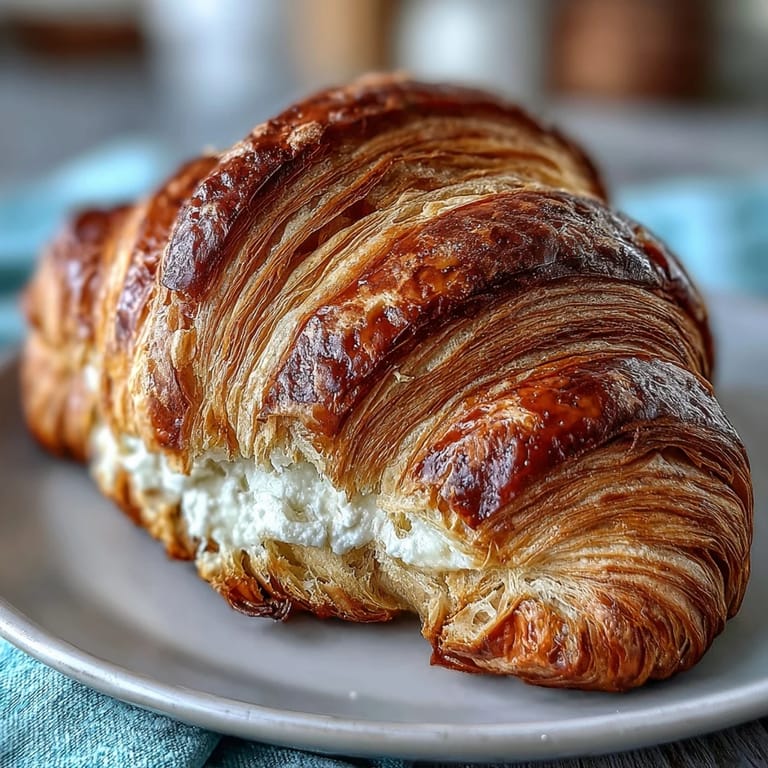
Lamination is just a fancy term for repeatedly folding butter into dough to create hundreds of thin, distinct layers. When those layers hit the oven heat, steam forms between them, pushing them apart and creating that signature crispy, flaky texture. The sourdough starter doesn't interfere with this process; it just adds flavor depth while the butter does all the structural work. Think of it as science meeting patience—each fold exponentially increases your layer count, which is why three turns create nearly 730 delicate sheets.
Troubleshooting Common Issues
If your butter starts leaking through the dough, your kitchen is probably too warm or you've let things sit too long between folds—pop everything back in the fridge for 20 minutes and start fresh. Dense, heavy croissants usually mean either the dough was underproofed before baking or the final rise didn't quite finish; trust that gentle poke test more than any timer. If the layers aren't separating properly, your butter block was likely too hard when laminating, so next time let it soften just a touch more before encasing it in dough.
Storage, Freezing, and Reheating
Fresh croissants are absolutely best eaten within a few hours, while they're still warm and the layers haven't had time to soften. However, life happens, so you can absolutely freeze unbaked, proofed croissants on a baking sheet, then transfer them to a freezer bag for up to 3 weeks—just add a few extra minutes to the bake time when cooking from frozen. To revive day-old croissants, wrap them loosely in foil and warm at 150°C (300°F) for about 5 minutes to restore some of that crispy exterior without drying them out completely.
- For best flavor, enjoy fresh croissants the day you bake them, while the butter is still soft and the crust still cracks satisfyingly.
- Frozen unbaked croissants work wonderfully for weekday mornings—just thaw and proof them overnight in the fridge.
- Store baked croissants in an airtight container for up to 2 days, though they're never quite the same as fresh.
 Save
Save These sourdough croissants remind me why baking is worth doing—you're not just feeding people, you're giving them something that tastes like care, technique, and genuine effort. Once you've made them once, you'll understand that they're absolutely worth the time.
Recipe Questions & Answers
- → How does sourdough starter affect the texture?
The sourdough starter adds natural fermentation, yielding a tangy flavor and a light, airy crumb with crisp layers.
- → What is the purpose of chilling the dough?
Chilling firms the butter and relaxes gluten, which helps create the distinct flaky layers during folding and baking.
- → Can I prepare croissants without a stand mixer?
Yes, dough can be mixed and kneaded by hand, though it requires more effort to achieve smooth elasticity.
- → How long should the dough proof before baking?
Proofing at room temperature for 2-3 hours allows the dough to double in size and develop a tender texture.
- → What alternatives exist for the egg wash?
A mixture of milk or cream applied lightly can also create a golden finish, though egg wash gives a richer shine.