 Save
Save I'll never forget the first time I assembled a board that felt truly elegant—it was for my sister's engagement party, and I wanted something that looked like it belonged in a luxury magazine. That's when I discovered the magic of the gilded edge: arranging everything along the perimeter of a beautiful board, leaving the center dramatically empty. It transformed a simple spread into something that made guests pause and actually admire it before diving in. That board has become my signature move ever since, and it's taught me that sometimes the most sophisticated presentations are about what you leave alone.
I remember my mother-in-law's face when she saw that first gilded edge board at the engagement party. She walked around it twice, examining every angle, then whispered to me, 'This is art.' That single moment made me realize a charcuterie board could be so much more than just food arranged on wood—it could tell a story about celebration, about caring enough to make something beautiful. Now whenever I make this, I think about creating that same magic for the people gathered around it.
Ingredients
- Triple-cream Brie, 120 g, cut into slim wedges: This is your luxe anchor—creamy enough to feel indulgent but sturdy enough to slice cleanly. Cut the wedges just before serving so the interior stays pristine and pale.
- Aged Manchego, 120 g, sliced: The nutty, slightly grainy texture contrasts beautifully with soft cheeses. Slice it about a quarter-inch thick so it holds its shape along the board's edge.
- Blue cheese, 100 g, crumbled or sliced: A tiny amount goes a long way here—it's the flavor anchor that makes everything taste more sophisticated. I prefer leaving it in chunks so people can decide how brave they're feeling.
- Goat cheese, 100 g, formed into small rounds: The tang and brightness of goat cheese feels fresh against rich cured meats. Rolling it gently into balls makes them look intentional and pretty.
- Prosciutto, 100 g, folded into ribbons: This is where you splurge a little—quality matters. Fold each slice loosely so it catches light and looks almost translucent and delicate.
- Thinly sliced salami, 120 g: Choose a variety that speaks to you, whether peppery or mild. The thinness means it drapes beautifully along the board's curve.
- Coppa or bresaola, 100 g: One of these brings textural contrast—coppa is fattier and silkier, bresaola leaner and more intense. I rotate depending on my mood.
- Red and green grapes, one small bunch each: Grapes do something magical on a board—they fill negative space and add pops of color without being fussy. Chill them just before serving so they feel refreshing.
- Ripe pear, thinly sliced: Use a mandoline if you have one, but a sharp knife works too. Toss the slices in a tiny bit of lemon juice to keep them from browning, then pat them dry before arranging.
- Crisp apple, thinly sliced: I always choose a variety that's tart—it balances the richness beautifully. Same lemon juice trick applies.
- Dried apricots, 1 small handful: These chewy little jewels bridge sweet and savory. I sometimes toast them briefly to deepen their flavor, but it's optional.
- Marcona almonds, 1/4 cup: Buttery and slightly sweet—they feel more refined than regular almonds. Toast them yourself if you want to taste the difference.
- Salted pistachios, 1/4 cup: The salt and color here are non-negotiable. They add visual interest and a satisfying crunch.
- Castelvetrano olives, 1/4 cup: These bright green, buttery olives are worth seeking out. They're milder than Kalamata, so they won't overpower the delicate cheeses.
- Cornichons, 1/4 cup: The vinegar cuts through richness like nothing else. I nestle these whole for a bright, tangy accent.
- Fig jam or quince paste, 1/4 cup: This is your sweet-savory anchor. Fig jam feels autumnal and luxe, while quince paste is slightly more refined. Either works in a small ramekin placed along the edge.
- Honeycomb or honey drizzle: Raw honeycomb is stunning—literally golden and textured. A honey drizzle works too, but that raw comb feels special on an elegant board.
- Baguette, thinly sliced and lightly toasted: Toast it just until it's warm and slightly crisp, so it doesn't go soft from moisture later. The toasting is important—soggy bread ruins everything.
- Assorted crackers, 1 box: Pick a mix of textures and flavors. Avoid anything too flavorful that would compete with delicate cheeses.
Tired of Takeout? 🥡
Get 10 meals you can make faster than delivery arrives. Seriously.
One email. No spam. Unsubscribe anytime.
Instructions
- Choose your canvas carefully:
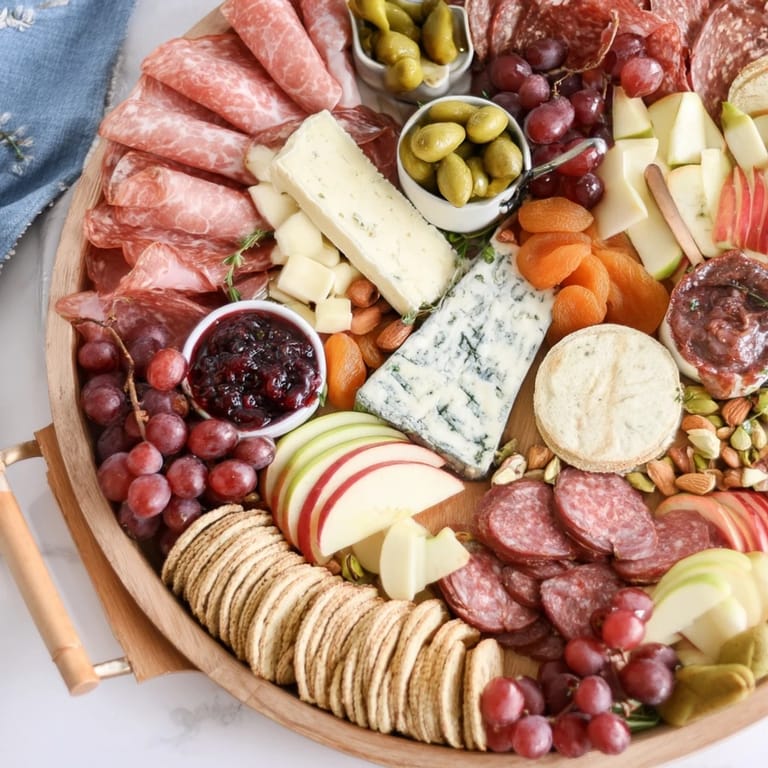
- Pull out your largest, most beautiful board—one with a prominent rim or edge that will frame everything. I use a large marble or wooden round board because the shape means there's a natural border to follow. Wipe it clean with a soft cloth. This board is part of the presentation, so it matters.
- Arrange cheeses first along the perimeter:
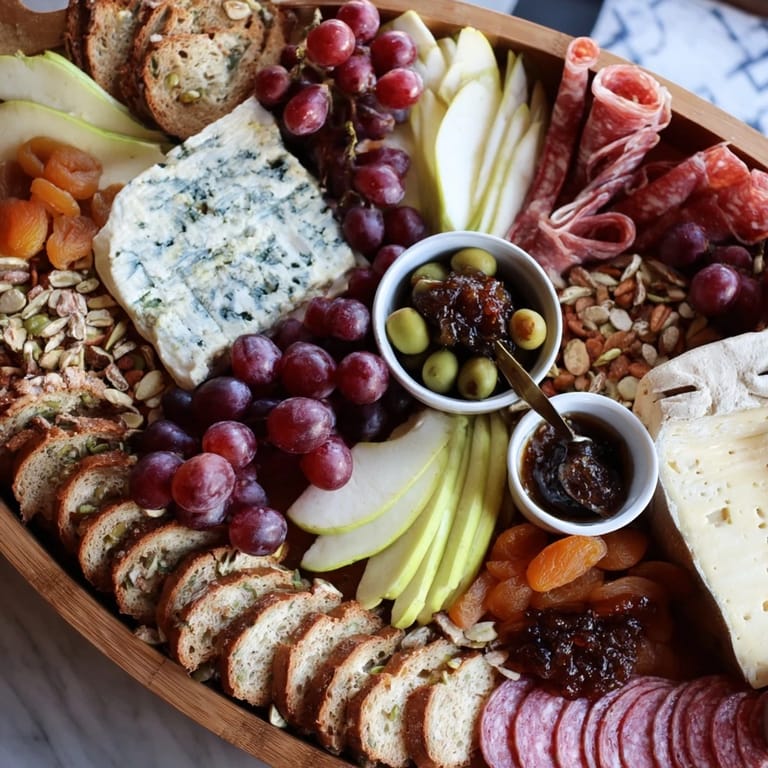
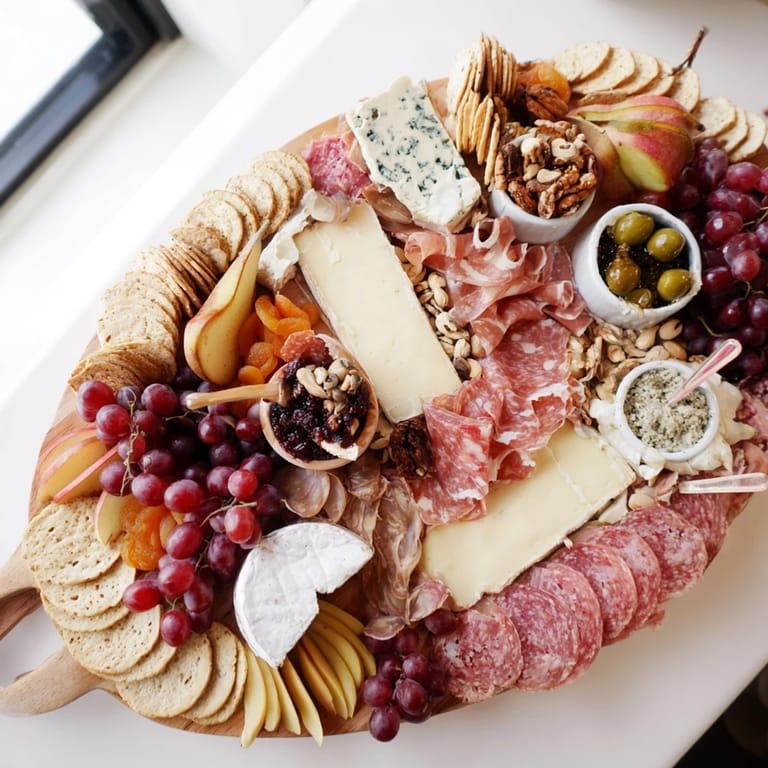
- Start with your cheeses placed strategically around the outer edge. Wedge the Brie so its pale interior shows. Fan the Manchego slices slightly. Place blue cheese in small piles or chunks. Nestle the goat cheese rounds evenly spaced. Think of them as anchors holding everything else in place.
- Layer in the cured meats with care:
- Fold the prosciutto loosely and tuck it between and beside cheese. Let the salami drape naturally—don't force it flat. Fold the coppa or bresaola to show off its color and translucence. The meat should feel interspersed with cheese, never clumped together.
- Fill gaps with fresh and dried fruit:
- Place the grape clusters so they're visible and accessible. Layer pear and apple slices in gentle overlapping fans. Scatter dried apricots in pockets between other ingredients. Fruit bridges colors and adds freshness visually and taste-wise.
- Add nuts and olives strategically:
- Sprinkle Marcona almonds and pistachios in small clusters—they catch light beautifully. Nestle Castelvetrano olives in their own little spots. These small elements make the board feel abundant without being chaotic.
- Position the condiments in small vessels:
- Place a small bowl or ramekin of fig jam or quince paste along the rim. Put the cornichons in another small dish or scatter them loose. If using honeycomb, place it where it catches light. These elements are functional and visual.
- Arrange bread and crackers around the edge:
- Lean toasted baguette slices against the rim. Stand some crackers up slightly. This creates height variation and makes the board feel dimensional. Leave some space so people can actually access everything.
- Step back and look for balance:
- Walk around your board. Are colors distributed evenly? Does the eye move naturally around the perimeter? Are there any large gaps that need filling? Rotate something if needed. Trust your eye here—this is where it becomes art.
- Leave the center completely empty:
- This is the secret. Your empty center lets the board's shape shine. It creates drama. It shows restraint. Don't be tempted to fill it—the emptiness is what makes this elegant.
- Serve at room temperature:
- Pull your board from the fridge about 30 minutes before serving. Cheese tastes and feels so much better when it's not cold. Leave cheese knives and small plates nearby so people know they're welcome to enjoy it.
 Save
Save There's a moment during every gathering where someone stands back from the board and just looks at it in silence. That's when I know it worked. They're seeing the geometry, the colors, the intentionality. That quiet moment of appreciation—before anyone takes a single bite—is why I keep making these boards. It's food, yes, but it's also conversation starter, moment maker, memory creator.
The Art of the Arrangement
Building a gilded edge board is less about following rules and more about understanding balance. Think about colors first—you want red grapes next to pale Brie, dark blue cheese near bright pistachios. Think about textures second—alternate creamy with crunchy, soft with firm. The board becomes a landscape where every element has a reason for being exactly where it is. Once you understand these principles, you can improvise with whatever beautiful ingredients you have on hand.
Pairing with Beverages
Champagne or sparkling wine is the obvious choice, and for good reason—the bubbles cut through richness and complement the elegance of the presentation. But I've also served this board with a crisp Sauvignon Blanc, and the herbal notes paired beautifully with the goat cheese and cured meats. If you're serving without alcohol, try sparkling water with fresh lemon or a nice ginger beer to add refreshment and cut through the richness.
Making It Your Own
This is your board, so make it yours. If you love aged cheddar more than Manchego, use that instead. If fig jam doesn't appeal to you, try apricot preserves or even pesto. For vegetarian guests, add marinated artichoke hearts, roasted red peppers, sun-dried tomatoes, or an extra wedge of your favorite cheese. The structure stays the same—it's the ingredients that flex to match your taste and what you can find at your market.
- Add edible gold leaf or gold-dusted nuts for extra festivity and visual drama
- Prep all ingredients the day before, storing them separately in the fridge, then assemble just an hour before guests arrive
- Use a beautiful board as your canvas—it should be something you'd be proud to display, because it will be the star of the show
 Save
Save Every time someone admires this board, I'm reminded that elegance isn't about expense or complexity—it's about intention. It's about knowing when to fill and when to leave empty, about letting beautiful ingredients speak for themselves. Make this board and watch what happens.
Recipe Questions & Answers
- → How should the cheeses be prepared for the board?
Cut triple-cream Brie into slim wedges, slice Manchego thinly, crumble or slice blue cheese, and shape goat cheese into small rounds for variety in texture and appearance.
- → What is the best way to arrange the board?
Arrange all items along the board's outer rim, following its shape closely, and leave the center section empty to emphasize the elegant form.
- → Can this be adapted for vegetarians?
Yes. Omit the charcuterie and add marinated artichoke hearts, roasted peppers, or extra cheeses to maintain variety and flavor.
- → What accompaniments enhance the flavor profile?
Include Marcona almonds, salted pistachios, Castelvetrano olives, cornichons, fig jam or quince paste, and a drizzle of honey or honeycomb for richness and contrast.
- → What serving temperature is recommended?
Serve at room temperature to bring out the full flavors of cheeses, fruits, and cured meats.
- → What beverages pair well with this board?
Pair with Champagne, sparkling wine, or a crisp Sauvignon Blanc for a balanced and festive experience.